
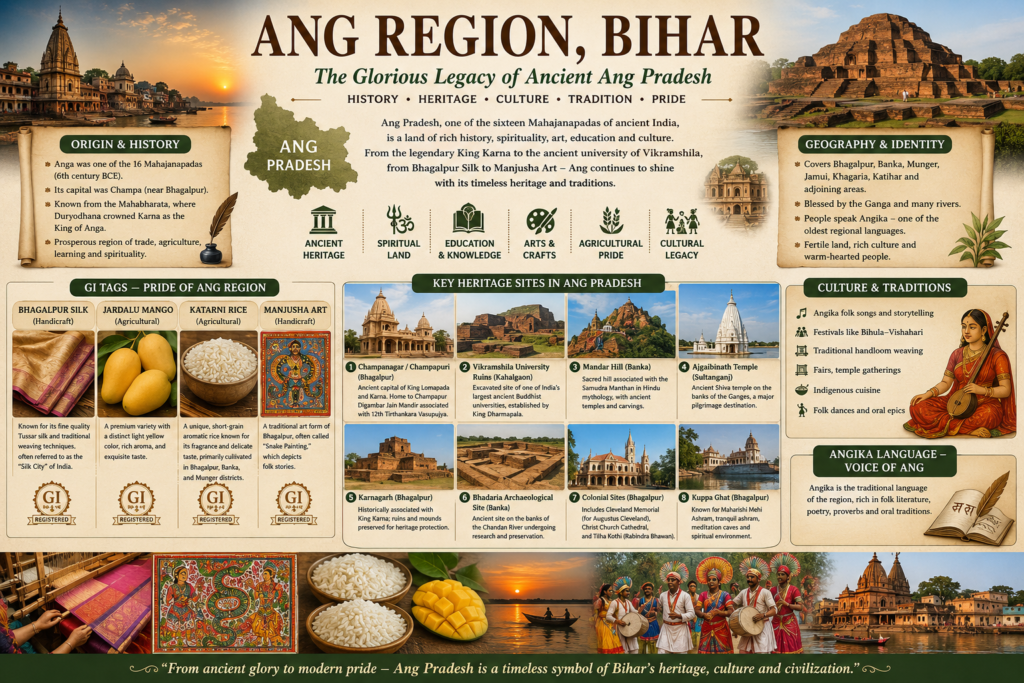
The Glorious Legacy of Ancient Ang Pradesh
Nestled in the eastern part of Bihar, the historic Ang region — traditionally known as Ang Pradesh or Anga Mahajanapada — is one of the oldest cultural and civilizational centers of the Indian subcontinent. This sacred land carries the echoes of ancient kingdoms, spiritual traditions, river-based trade, folk culture, education, and artistic excellence that have flourished here for thousands of years.
From the legendary kingdom of Karna to the scholarly brilliance of Vikramshila University, from the vibrant colors of Manjusha Art to the world-renowned Bhagalpur Silk, the Ang region reflects a living heritage where history and tradition continue to shape everyday life.
Even today, the fragrance of Katarni rice, the sweetness of Jardalu mangoes, the sound of silk looms, and the melodies of Angika folk songs preserve the timeless soul of this ancient land.
Origin of Ang Region
The name “Ang” or “Anga” is deeply rooted in Indian mythology and ancient history. References to Anga are found in the Mahabharata, Ramayana, Buddhist literature, Jain texts, and several Puranas. According to mythological traditions, the kingdom was founded by King Anga, a descendant of the legendary King Yayati.
Historically, Anga emerged as one of the Sixteen Mahajanapadas of ancient India during the 6th century BCE. Its capital was the ancient city of Champa, believed to be situated near present-day Bhagalpur.
Ancient Champa was a flourishing urban and trade center located along important river routes. The prosperity of Anga came from agriculture, trade, river transport, craftsmanship, and cultural exchange.
Anga in Ancient Indian History
The Ang region occupies a special place in Indian historical and epic traditions. During the Mahabharata era, Anga became famous when Duryodhana crowned Karna as the King of Anga. Karna’s generosity, bravery, and loyalty transformed the region into a symbol of honor and heroism.
Later, Anga came under the control of the powerful Magadha kingdom during the reign of King Bimbisara. Despite political changes, the region retained its distinct cultural and economic importance.
Ancient Buddhist and Jain texts describe Anga as a prosperous land visited by monks, scholars, merchants, and travelers. Because of its strategic location near the Ganga and eastern trade routes, Anga developed as an important center of commerce and learning.
Geography of Present-Day Ang Region
In the modern context, the Ang region broadly includes the eastern districts of Bihar such as:
- Bhagalpur
- Banka
- Munger
- Jamui
- Khagaria
- Katihar
- Parts of Purnia and adjoining regions
The region is blessed by the sacred Ganga River and several tributaries that have supported agriculture, trade, and civilization for centuries. Fertile plains, riverbanks, hills, forests, and ancient settlements together define the geographical character of Ang Pradesh.
The traditional language of the region is Angika, one of the oldest regional languages of eastern India, rich in folk literature and oral traditions.
Silk Heritage and Ancient Trade Connections
One of the greatest identities of the Ang region is its internationally renowned silk tradition.
Bhagalpur is popularly known as the “Silk City of India” because of its centuries-old silk weaving heritage. Bhagalpur’s famous Tussar Silk has been admired for generations because of its fine texture, natural sheen, and craftsmanship.
Historians believe that silk produced in this region once moved through ancient trade routes connecting eastern India with Bengal and beyond, contributing to broader commercial networks often associated with the historical Silk Route traditions.
Even today, thousands of artisan families continue traditional weaving practices on handlooms, preserving one of the oldest living craft traditions of India.
GI Tags and Traditional Pride of Ang Region
The Ang region of Bihar is culturally and economically distinguished through several prestigious Geographical Indication (GI) tagged products. These GI tags recognize the originality, traditional craftsmanship, agricultural uniqueness, and regional identity associated with the products of this historic land.
Bhagalpur Silk (Handicraft)
Bhagalpur Silk is among the most celebrated cultural identities of the Ang region. The city of Bhagalpur is widely known as the “Silk City of India” because of its rich and ancient silk weaving tradition.
Bhagalpur is especially famous for its fine-quality Tussar Silk, admired for its elegance, durability, and natural texture. Traditional weaving techniques have been preserved by skilled artisan families for generations, making Bhagalpur Silk a symbol of artistic excellence and cultural continuity.
The GI Tag awarded to Bhagalpur Silk recognizes both the uniqueness of the product and the centuries-old weaving heritage of the region.
Jardalu Mango (Agricultural)
Jardalu Mango is regarded as one of Bihar’s premium mango varieties. Cultivated mainly in and around Bhagalpur, this mango is famous for its distinctive light yellow color, rich aroma, smooth pulp, and exquisite sweetness.
Its exceptional taste and fragrance have made it highly valued across India and international markets. The GI Tag granted to Jardalu Mango protects its regional identity and highlights the agricultural excellence of the Ang region.
Katarni Rice (Agricultural)
Katarni Rice is a unique short-grain aromatic rice variety primarily cultivated in the districts of Bhagalpur, Banka, and Munger.
Celebrated for its delicate taste, soft texture, and natural fragrance, Katarni rice has remained an important part of local culinary traditions for generations. Its flattened form, popularly known as Katarni Chura, is equally cherished in traditional households and festivals.
The GI Tag recognizes the distinct cultivation methods and geographical uniqueness associated with this heritage crop of Ang Pradesh.
Manjusha Art (Handicraft)
Manjusha Art is one of the oldest and most distinctive folk art traditions of Bihar. Originating from Bhagalpur, this vibrant art form is often referred to as “Snake Painting” because of its serpent motifs and association with the folk legend of Bihula-Bishahari.
The paintings traditionally depict stories of devotion, sacrifice, mythology, and local folklore using bold outlines and vivid natural colors. Manjusha Art reflects the spiritual imagination and cultural identity of the Ang region.
The GI Tag has played a vital role in preserving this rare artistic tradition and supporting the local artisans who continue to keep the heritage alive.
Heritage Sites of Ang Region
The Ang region is home to several remarkable heritage sites that reflect its ancient civilization, mythology, spirituality, educational excellence, and colonial history.
Champanagar / Champapuri (Bhagalpur)
Champapuri is regarded as the ancient capital of Ang Pradesh and is associated with King Lomapada and the legendary Karna of the Mahabharata.
The site is also an important Jain pilgrimage center because of the famous Champapur Digambar Jain Mandir, linked with the 12th Jain Tirthankara Vasupujya.
Vikramshila University Ruins (Kahalgaon)
Vikramshila University was one of the world’s greatest Buddhist universities, established during the 8th century CE by King Dharmapala of the Pala dynasty.
The excavated ruins reveal monasteries, meditation halls, stupas, and educational complexes that symbolize the intellectual glory of ancient India.
Mandar Hill (Banka)
Mandar Hill is a sacred hill associated with the mythological Samudra Manthan or churning of the ocean.
The hill contains ancient temples, sacred ponds, carvings, and spiritual sites important to both Hindu and Jain traditions.
Ajgaibinath Temple (Sultanganj)
Ajgaibinath Temple is an ancient Shiva temple located on the banks of the Ganga River.
The temple becomes a major pilgrimage center during the Shravani Mela when lakhs of devotees collect holy water from Sultanganj before beginning their journey to Deoghar.
Karnagarh (Bhagalpur)
Karnagarh is traditionally associated with King Karna. Today, the ruins and ancient mounds found here continue to attract historical interest and discussions for preservation.
Bhadaria Archaeological Site (Banka)
Bhadaria Archaeological Site situated on the banks of the Chandan River is an important archaeological location where ongoing research continues to uncover evidence of ancient settlements and civilization.
Colonial Heritage Sites of Bhagalpur
The colonial-era architecture of Bhagalpur also forms an important part of the region’s heritage.
Notable landmarks include:
- Cleveland Memorial
- Christ Church Cathedral
- Tilha Kothi, presently known as Rabindra Bhawan
These structures preserve the architectural and administrative legacy of the colonial period.
Kuppa Ghat (Bhagalpur)
Kuppa Ghat is a serene spiritual destination located on the banks of the Ganga River.
The site is famous for the Maharishi Mehi Ashram, meditation caves, and peaceful spiritual environment that attracts devotees and seekers from across the country.
Folk Culture and Traditions
The culture of Ang Pradesh is deeply rooted in community life, spirituality, folklore, and artistic expression.
Key cultural traditions include:
- Angika folk songs and storytelling
- Bihula-Bishahari festival traditions
- Handloom weaving communities
- Rural fairs and temple gatherings
- Indigenous food traditions
- Folk dance and oral epics
The people of Ang are known for their simplicity, hospitality, and strong emotional connection to their cultural roots.
Angika Language – The Voice of Ang
Angika is the traditional language and cultural identity of the Ang region. Spoken across eastern Bihar and neighboring areas, Angika preserves ancient linguistic traditions through folk songs, poetry, proverbs, and oral storytelling.
In recent years, scholars, artists, and cultural organizations have intensified efforts to preserve and promote Angika language and literature.
Ang Region in Contemporary Times
Today, the Ang region stands at the intersection of heritage and development. Its historical sites, silk industry, GI-tagged products, folk art traditions, and spiritual tourism continue to contribute to Bihar’s cultural and economic identity.
Efforts to preserve Vikramshila University, promote Manjusha Art, strengthen Bhagalpur Silk industries, and protect archaeological sites are helping reconnect younger generations with the glorious legacy of Ang Pradesh.
Conclusion
The Ang region of Bihar is not merely a geographical territory — it is a timeless civilization shaped by history, spirituality, education, trade, art, agriculture, and human resilience.
From the legendary kingdom of Karna to the scholarly brilliance of Vikramshila, from the sacred heights of Mandar Hill to the vibrant traditions of Manjusha Art and Bhagalpur Silk, every corner of Ang carries the memory of a glorious past.
In an era of rapid modernization, preserving the heritage of Ang Pradesh is not only about safeguarding monuments or traditions — it is about protecting the living soul of one of India’s oldest and most culturally rich civilizations.