
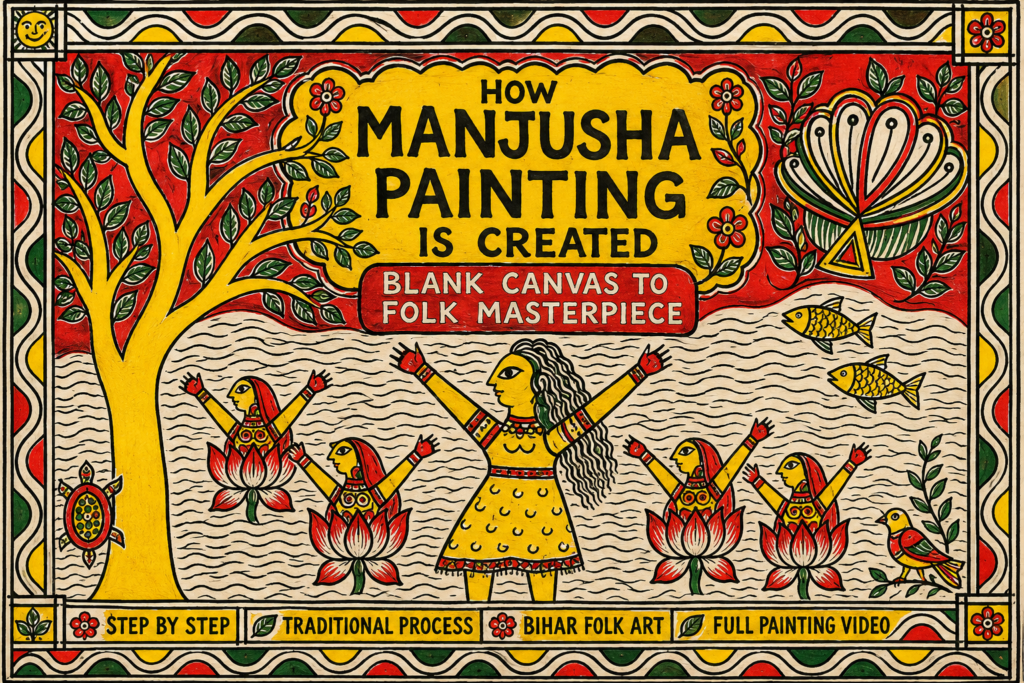
How Manjusha Painting is Created: From Blank Canvas to Folk Masterpiece
Understanding the Structure of Manjusha Art
Manjusha Art is one of Bihar’s oldest and most distinctive folk painting traditions. Originating from the Ang region of Bihar, especially Bhagalpur, this art form is closely associated with the Bihula-Bishari folklore and represents a unique visual storytelling tradition.
Unlike many other Indian folk arts, Manjusha paintings follow a highly structured visual grammar. Every element—from the borders to the figures, motifs, and colors—has a symbolic meaning.
In this article, we reverse-engineer a traditional Manjusha painting and understand how a blank canvas gradually transforms into a complete folk masterpiece.
Step 1: Beginning with a Blank Canvas
Every Manjusha painting starts with a plain white surface. The artist first visualizes the entire composition before making the initial lines.
Unlike free-form painting styles, Manjusha art follows a planned arrangement where each motif has a designated position.
Step 2: Drawing the Sacred Borders
Borders are among the most important elements of Manjusha paintings.
Traditional decorative borders include:
- Lehariya (wave patterns)
- Triangle motifs
- Belpatra patterns
- Serpentine designs
These borders frame the story and provide balance to the entire composition.
Step 3: Dividing the Space
The artist determines the main narrative area.
Water lines, landscape divisions, and open spaces are created to accommodate figures, trees, animals, and symbolic elements.
The composition itself becomes a storytelling stage.
Step 4: Creating the Tree of Life
Large trees frequently appear in Manjusha paintings.
The tree symbolizes:
- Life
- Nature
- Growth
- Continuity
The branches spread across the composition and connect different elements of the story.
Step 5: Adding Water Patterns
Parallel wavy lines represent rivers and flowing water.
These rhythmic patterns create movement and are one of the most recognizable characteristics of Manjusha Art.
Step 6: Drawing the Main Character
The central figure often occupies the largest space.
Typical features include:
- Fish-shaped eyes
- Sharp nose profile
- Extended arms
- X-shaped body posture
- Decorative ornaments
This X-shaped arrangement is one of the defining characteristics of Manjusha figures.
Step 7: Lotus and Supporting Figures
Smaller figures frequently emerge from lotus flowers.
The lotus symbolizes:
- Purity
- Spirituality
- Renewal
Multiple figures arranged around the main character create rhythm and balance.
Step 8: Symbolic Motifs
Manjusha paintings include several recurring motifs:
- Fish
- Turtle
- Birds
- Trees
- Flowers
- Kalash
- Serpents
These symbols are not decorative alone; they contribute to the narrative and cultural meaning of the artwork.
Step 9: Traditional Color Palette
One of the strongest identities of Manjusha Art is its limited color scheme.
Traditional colors include:
- Yellow
- Red or Pink
- Green
Black outlines define every figure and motif.
Flat color filling without shading preserves the folk character of the painting.
Step 10: Final Detailing
The final stage includes:
- Strengthening outlines
- Adding leaf patterns
- Decorative textures
- Completing borders
- Balancing empty spaces
At this stage, the painting transforms into a complete visual story.
The Reverse Engineering Formula of Manjusha Art
The structure of a traditional Manjusha painting generally follows this sequence:
Border → Space Division → Nature → Main Figure → Supporting Figures → Symbols → Colors → Details → Complete Story
Understanding this sequence allows artists, students, and enthusiasts to create authentic Manjusha compositions from a blank canvas.
Why Manjusha Art Matters Today
Manjusha Art is not merely a painting tradition.
It represents:
- The cultural heritage of Ang Pradesh
- Visual storytelling traditions
- Folk symbolism
- Traditional aesthetics
- The identity of Bhagalpur and Bihar
Preserving and promoting Manjusha Art helps keep this centuries-old artistic heritage alive for future generations.
Conclusion
A Manjusha painting is much more than lines and colors.
From the first border to the final outline, every element serves a purpose. Every motif tells a story.
A blank canvas gradually becomes a living narrative of culture, folklore, and artistic tradition.
That is the true beauty of Manjusha Art.