Ang Pradesh: The Forgotten Heritage of Eastern Bihar
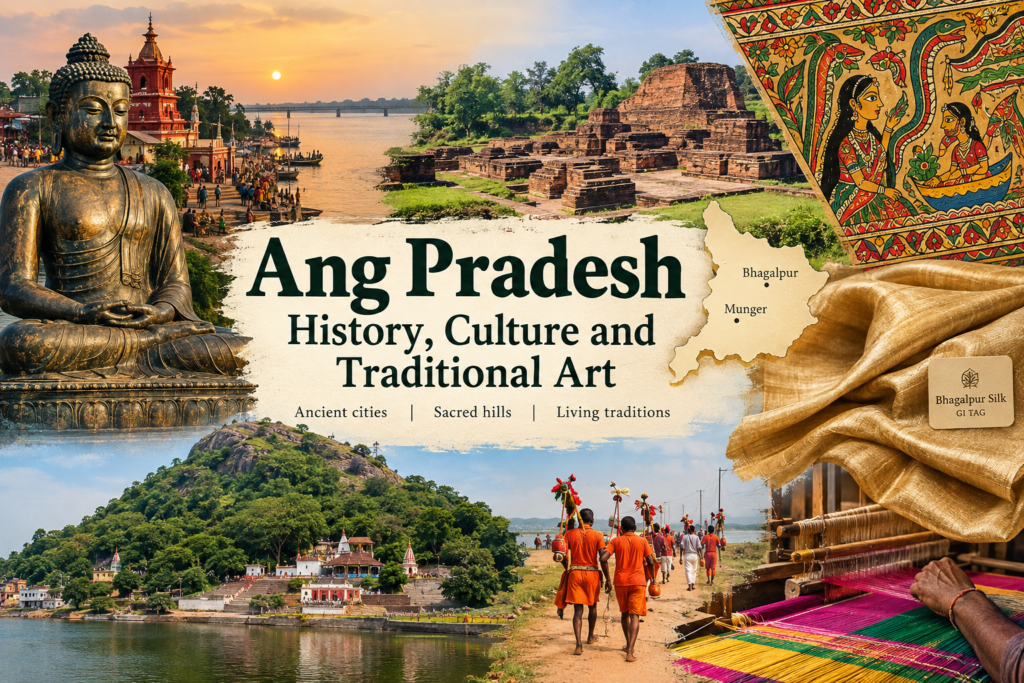
Some people know Bhagalpur for its silk. Others recognise the name Vikramshila from the history of Buddhism. Many have heard the story of Karna, the warrior who became the king of Anga. But these are not separate stories. They are different pieces of a much larger regional history.
Ang Pradesh has something particularly interesting about it: its past is still visible in everyday life. The language people speak, the paintings made by local artists, the fabric woven on traditional looms and the festivals celebrated in villages all carry traces of an older cultural world.
To understand this part of Bihar, it helps to look beyond its famous landmarks and explore the people, beliefs and creative traditions that have kept its identity alive.
Where Was Ancient Anga?
Anga was one of the important political regions of ancient India. Its historical heartland lay in what is now eastern Bihar, particularly around Bhagalpur and Munger. The wider cultural region is also associated with Banka, Jamui, Khagaria and neighbouring parts of Jharkhand.
Ancient kingdoms did not follow today’s district boundaries, so it would be misleading to draw a precise modern map of Anga. What matters is its location. The Ganga and the surrounding plains connected settlements, supported agriculture and offered routes for merchants travelling between different parts of the subcontinent.
The region’s name also appears in religious traditions. A popular story associated with the Ramayana connects the name Anga with the Sanskrit word anga, meaning a limb, through a legend involving Shiva and Kamadeva. This belongs to the realm of traditional belief rather than established historical explanation.
Anga’s importance, however, does not depend on a legend about its name. Ancient texts recognise it as a significant region, and its capital, Champa, was known beyond the immediate area. The kingdom’s history places eastern Bihar firmly within the political and commercial life of ancient India.
Champa: The City That Put Anga on the Ancient Map
Long before Bhagalpur became known for its textile industry, the ancient city of Champa was an important centre of the Anga kingdom. It is traditionally associated with the area around present-day Champanagar and Champapur in Bhagalpur.
Champa appears in Buddhist literature among the important cities of its time. Its position near the Ganga and the Champa River made it suitable for trade and travel. In an age when rivers served as major transport routes, such a location could bring merchants, travellers and religious communities together.
Anga is mentioned in early Indian literature, including the Atharvaveda. Later, it became one of the sixteen Mahajanapadas described in Buddhist tradition. These were major political territories that shaped the history of northern India during the period associated with the Buddha and Mahavira.
Anga eventually lost its independence as Magadha expanded. Tradition credits the Magadhan ruler Bimbisara with conquering the kingdom. Although its political identity changed, the region remained culturally significant.
Champa also has an important place in Jain tradition. Champapuri is revered as a sacred site associated with Vasupujya, the twelfth Jain Tirthankara. This religious connection adds another layer to the heritage of the Bhagalpur region.
Today, Champanagar is worth exploring not only for its historical associations but also for its connection with local religious practices and the folk stories that continue to inspire traditional artists.
Karna’s Connection with Anga: History Meets the Mahabharata
Few characters from the Mahabharata have captured the imagination of readers quite like Karna. Remembered for his generosity, loyalty and tragic circumstances, he is closely associated with Anga because Duryodhana made him its king.
The episode is one of the epic’s most memorable moments. Karna, whose birth and social position had become obstacles to his acceptance among the warriors of his time, receives a kingdom and the recognition of a royal title. From then on, he is remembered as Angaraja, the king of Anga.
In Bhagalpur, Karnagarh near Nathnagar is associated by local tradition with Karna. Such places are an important part of regional memory, even when their connection with an epic character cannot be conclusively established through archaeology.
That distinction matters. A place can have enormous cultural value because of the stories attached to it, without every detail of the story being historically verifiable. Ang Pradesh offers many such examples, where mythology, local identity and historical research meet.
Vikramshila: When Bhagalpur Was a Centre of Buddhist Scholarship
One of the strongest reasons to pay attention to Ang Pradesh is Vikramshila Mahavihara, the remains of a major Buddhist learning centre at Antichak, near Kahalgaon in Bhagalpur district.
Vikramshila was established during the Pala period, traditionally attributed to King Dharmapala around the late eighth or early ninth century. It became one of the leading Buddhist institutions of eastern India, alongside Nalanda and Odantapuri.
This was not simply a monastery where monks lived and prayed. Vikramshila developed a reputation for serious scholarship, particularly in Buddhist philosophy and Vajrayana traditions. Its teachers and students participated in intellectual networks that reached well beyond the region.
The scholar most closely associated with its wider legacy is Atisha Dipankara Shrijnana. After serving at Vikramshila, Atisha travelled to Tibet in the eleventh century. His teaching played an important role in the development and revival of Tibetan Buddhist traditions.
It is a remarkable connection: a historic institution in today’s Bhagalpur district contributed to religious and philosophical developments across the Himalayas.
What Remains of Vikramshila Today?
Archaeological excavations have revealed a large monastic complex, with a broad square layout, residential cells arranged around a courtyard and a central cruciform stupa. Other remains include votive stupas, structural foundations and decorative terracotta plaques.
The plaques offer glimpses of the artistic world of the time. Religious figures, animals and other scenes appear in the surviving material, showing that the site’s significance extended beyond its role as a centre of learning.
Vikramshila is generally believed to have declined during the military upheavals that affected Buddhist institutions in eastern India towards the end of the twelfth century. The precise circumstances of its destruction and abandonment remain subjects of historical study.
Archaeological work at Antichak has continued at different times. In February 2024, reports announced the resumption of excavation by the Archaeological Survey of India after a long gap. Further research may help answer questions about the institution’s buildings, activities and place in the wider Buddhist world.
For anyone interested in Bihar’s heritage, Vikramshila deserves to stand alongside better-known historical destinations. Its remains are a reminder that this region once attracted scholars whose influence reached far beyond India.
The Sultanganj Buddha: A Remarkable Piece of Lost Heritage
Sultanganj, beside the Ganga in Bhagalpur district, is known today for its religious importance. It is also the place where one of India’s most remarkable ancient metal Buddha sculptures was discovered.
The statue came to light in 1861–62 during railway construction work supervised by British engineer E. B. Harris. Made from copper alloy, it stands approximately 2.3 metres tall and weighs around 500 kilograms. Its size and workmanship demonstrate the considerable technical skill involved in ancient Indian metal casting.
The sculpture is generally dated to between the fifth and seventh centuries CE. It was transported to England and became part of the collection of the Birmingham Museum and Art Gallery, where it remains an important example of early Indian Buddhist art.
Its journey away from Bihar is an important part of the story, too. The statue demonstrates the artistic sophistication of the region, while raising questions about how cultural objects discovered during the colonial period came to be held in overseas collections.
Today, the Sultanganj Buddha links the history of Bhagalpur with a much wider discussion about India’s artistic heritage and the preservation of historical objects.
Sultanganj and the Living Tradition of the Kanwar Yatra
Sultanganj’s importance is not confined to archaeology. Every year during Sawan, the town becomes an important starting point for devotees taking part in the Kanwar Yatra.
Pilgrims collect Ganga water near the Ajgaivinath Shiva temple and carry it to sacred destinations, including Baba Baidyanath Dham in Deoghar, Jharkhand. The journey brings together religious devotion, physical endurance and a network of local communities that support pilgrims along the way.
For visitors, this is another side of Ang Pradesh’s heritage: not something preserved behind glass or displayed in museum cases, but a tradition experienced by thousands of people through movement, prayer and shared effort.
Mandar Hill: A Sacred Landscape Shared by Two Faiths
About 45 kilometres south of Bhagalpur, in Banka district, Mandar Hill rises from the surrounding landscape as one of the area’s best-known religious landmarks.
In Hindu mythology, the hill is associated with Mount Mandarachal, the mountain used as the churning rod during the Samudra Manthan. The story is deeply embedded in Hindu tradition, and the surrounding sacred sites draw visitors who come to explore its religious associations.
The Papharni pond lies near the foot of the hill, while temples and other religious structures contribute to the area’s spiritual atmosphere. Mandar Hill also holds significance for Jains through its association with Vasupujya.
The annual Bounsi Mela, traditionally held around Makar Sankranti in January, brings together worshippers, traders, visitors and local communities. The fair is as much a social gathering as a religious event, offering a glimpse of rural life and regional customs.
Mandar Hill is a good example of the cultural variety found in Ang Pradesh. Its importance comes from more than one religious tradition, and its surroundings continue to serve as a meeting place for people from different communities.
Angika: The Language That Keeps Local Memory Alive
Travel through Bhagalpur and the surrounding region, and one of the clearest signs of local identity is the sound of Angika.
Angika is an Indo-Aryan language spoken in the Bhagalpur and Munger belt and in neighbouring areas, including parts of Jharkhand. It carries a rich oral tradition of songs, sayings, stories and everyday expressions that have been passed down through families and communities.
Its classification has been debated for many years. Some linguistic classifications have grouped it with or treated it as a variety of Maithili, while many speakers insist on recognising Angika as a distinct language. The question is closely connected with cultural identity and demands for greater official recognition.
Angika has been associated historically with writing systems such as Anga Lipi and Kaithi, while Devanagari is widely used today. Much of its cultural strength, however, lies in spoken traditions: folk songs, oral histories, local expressions and stories shared at home or during festivals.
Languages preserve more than words. They hold local ways of describing nature, relationships, humour and belief. Supporting Angika through education, literature, recordings and digital publishing is one way to preserve the cultural memory of Ang Pradesh.
Manjusha Art: The Folk Painting Tradition of Bhagalpur
Among the region’s living art forms, Manjusha Art has a particularly close connection with the stories and beliefs of Ang Pradesh. Associated with Bhagalpur, it is a narrative folk tradition in which pictures and decorative motifs help tell the legend of Bihula and Bishahari.
Unlike a painting made only to decorate a wall, a traditional Manjusha composition can be understood as part of a larger story. Its figures, symbols and borders work together to communicate episodes from local folklore.
The tradition is closely linked with the worship of Manasa, the serpent goddess known locally as Bishahari. The story that inspires the paintings remains one of the best-known folk narratives associated with the region.
The Story of Bihula and Bishahari
The folk tale centres on Bihula, her husband Bala, the merchant Chand Sadagar and the goddess Manasa. In the story, Chand Sadagar refuses to worship the goddess, leading to a conflict that ends with Bala being bitten by a snake on his wedding night.
Bihula refuses to give up. She sets out on a difficult journey with her husband’s body, determined to seek divine help and bring him back to life. Her courage and devotion become the heart of the narrative.
Different tellings of the legend may vary in their details, but the central themes remain familiar: a woman’s determination, the power of faith, the tension between human pride and divine authority, and the hope of overcoming tragedy.
The story is remembered through local rituals and Bishahari Puja, associated with the traditional festival period around Nag Panchami. Champanagar is among the places linked with the worship of the goddess.
Local accounts also refer to a manuscript of the Bihula-Bishahari story in Kaithi script at Ishakchak in Bhagalpur. Such records, along with oral versions of the tale, are valuable for understanding how regional stories have survived.
What Makes Manjusha Painting Distinctive?
The easiest way to recognise traditional Manjusha Art is through its limited colour palette, strong outlines and carefully designed borders.
- Three principal colours: Pink or red, green and yellow form the characteristic palette, usually combined with black outlines and a light background.
- Important borders: Wavy lines, triangles, leaf-inspired designs and snake patterns frame the composition and contribute to its distinctive appearance.
- Recognisable figures: Bihula, Bala, Bishahari and Chand Sadagar appear alongside other figures and symbols connected with the story.
- Nature-inspired details: Snakes, fish, birds, flowers, lotuses, the sun and the moon help build the visual language of the paintings.
- A storytelling approach: Images and motifs can be arranged to narrate events, making the art closely connected with oral tradition rather than decoration alone.
These features distinguish Manjusha from other folk painting traditions of Bihar. Its particular palette and border patterns are especially important to preserving the identity of the art form.
How Manjusha Art Survived
Traditional Manjusha Art has been associated with artisan families, particularly from Mali and Kumbhakar communities. Local tradition connects the Mali community with the story of Lahsan Mali, who is said to have decorated Bihula’s raft.
During the twentieth century, the art faced a serious decline. As traditional practices became less common, the number of active practitioners reduced, putting the continuity of the style at risk. Chakravarti Devi of Champanagar is widely remembered for helping preserve the tradition. Artists including Jyotish Chand Sharma and Nirmala Devi also contributed to revival efforts associated with the Bihar government’s information department during the 1980s.
Later artists and cultural organisations helped bring Manjusha paintings to exhibitions, workshops and wider audiences. The art has also found new applications in wall hangings, textiles, painted boxes, stationery and contemporary decorative products.
A major milestone came in 2021, when Manjusha Art received Geographical Indication registration. The recognition strengthens its association with the region and helps distinguish it as a traditional art form with a specific cultural identity.
For readers who want to explore its history, motifs and stories in greater detail, see this guide to Manjusha Art from Bhagalpur.
The challenge now is to make the art economically sustainable without losing the features that make it distinctive. Workshops, exhibitions, responsible adaptation and fair opportunities for artists can all play a role in keeping it alive.
Bhagalpuri Silk: A Craft Woven into the Region’s Identity
Ask someone to name a product associated with Bhagalpur, and silk is likely to be one of the first answers. The city is widely known as India’s Silk City, with a weaving tradition that has given the region a distinctive place in India’s textile heritage.
Bhagalpuri silk, especially Tussar silk, is valued for its textured surface, natural appearance and understated sheen. It is used in sarees, dupattas, stoles, dress materials and a range of other garments. Depending on the yarn and weaving technique, the finished fabric may be simple and understated or richly patterned.
Behind every textile is a chain of work. Weavers, dyers, traders and other skilled workers contribute to the process, often drawing on knowledge passed down through generations. Nathnagar and other areas around Bhagalpur are associated with the region’s weaving activity.
Bhagalpur Silk received Geographical Indication registration in 2013. The recognition helps establish its regional identity, although buyers should still check product descriptions and the reliability of sellers when looking for genuine handloom textiles.
The Challenges Behind the Silk Label
The reputation of Bhagalpuri silk does not mean that the people who make it have an easy livelihood. Traditional weavers face pressures from rising costs, changing demand, competition from machine-made imitations and the difficulty of receiving a fair share of the final selling price.
For consumers, the difference between a genuine handloom product and a fabric merely marketed with a regional name is important. Clear information about material, production method and origin helps buyers make better choices.
Buying from reputable handloom sellers or artisan groups can help strengthen the connection between customers and producers. It also encourages greater transparency in a market where the story behind the fabric matters as much as its appearance.
Bhagalpuri silk is not simply a fashion label. It represents the skills and livelihoods of people whose work has helped define the region for generations.
For a closer look at the textile tradition, read more about Bhagalpuri silk, its weaving heritage and its place in Bihar’s textile culture.
Festivals That Bring Ang Pradesh Together
Much of the region’s cultural life can be understood through its festivals. They bring religious belief, seasonal customs, family gatherings and community participation together in ways that are difficult to capture through monuments alone.
Chhath Puja
Chhath Puja is one of Bihar’s most important festivals. Devotees offer prayers to the setting and rising Sun, often gathering beside rivers, ponds and other water bodies. The observance involves fasting, traditional offerings and a strong emphasis on discipline and devotion.
In Ang Pradesh, as elsewhere in Bihar, Chhath is also a festival of family memory. Folk songs, the preparation of offerings and gatherings at the water’s edge connect people with their homes and communities. For those living away from the region, the festival often brings back memories of childhood and village life.
Bishahari Puja
Bishahari Puja is closely associated with the serpent goddess and the Bihula-Bishahari story. Its rituals have helped keep the folklore alive and provide the cultural setting from which Manjusha Art developed.
Shiva Worship and Sawan
Shiva worship is another important part of regional religious life. During Sawan, devotees visit places such as Ajgaivinath in Sultanganj and join the wider Kanwar pilgrimage to Shiva temples in Bihar and Jharkhand.
Durga Puja, Kali Puja, Diwali, Holi and other celebrations are also part of the region’s annual calendar. Their local forms reflect the customs, tastes and community traditions of the people who celebrate them.
Crafts, Local Creativity and Everyday Culture
Ang Pradesh’s creative identity extends beyond Manjusha paintings and silk textiles. Traditional motifs are finding their way onto decorative objects, handmade gifts, fabric accessories, notebooks and home décor.
Snakes, flowers, fish, birds and geometric borders offer artists a visual vocabulary rooted in the region’s folklore. When used thoughtfully, these motifs can introduce traditional art to new audiences without separating it from its origins.
Contemporary craft products can create opportunities for artists, particularly when traditional skills are combined with good design, accurate storytelling and fair payment. However, adapting an art form for modern products should not mean ignoring the communities that developed it.
Local food and everyday customs are equally important parts of this heritage. Rice, pulses, seasonal vegetables and regional sweets feature in household and festival cooking, with recipes varying from one locality to another. These ordinary practices, along with Angika conversation and folk songs, make the region’s identity something people experience every day.
Places to Visit Around Ang Pradesh
For anyone planning to explore the region, a visit can combine archaeology, religious sites, local markets and traditional crafts. A few places offer a useful starting point.
- Vikramshila, Antichak: Visit the archaeological remains of the Buddhist Mahavihara near Kahalgaon and learn about its role in the history of Buddhist scholarship.
- Champanagar and Champapur: Explore places associated with ancient Champa, Jain traditions and the local stories of Bishahari.
- Sultanganj: See the riverside setting of Ajgaivinath Shiva temple and learn about the town’s importance during Sawan. The famous Sultanganj Buddha is now held in Birmingham, England.
- Mandar Hill, Banka: Explore the sacred hill, nearby religious sites and the Papharni pond. January is associated with the traditional Bounsi Mela.
- Nathnagar and Bhagalpur’s textile areas: Learn about silk weaving and, where possible, purchase textiles from reliable local producers.
- Bhagalpur Museum: Explore regional collections and exhibitions, subject to current opening arrangements.
Opening hours and access arrangements can change, so it is sensible to check details before travelling. Visitors interested in traditional arts may also find craft exhibitions and artisan workshops more rewarding than a quick visit to a market.
What the Future Holds for Ang Pradesh’s Heritage
Ang Pradesh has no shortage of stories. The challenge is making sure that they are documented accurately, shared widely and supported by opportunities for the people who keep them alive.
Archaeological research can deepen our understanding of ancient Champa and Vikramshila. Language projects can preserve Angika songs and oral histories. Schools, museums and cultural organisations can introduce younger generations to regional traditions, while digital publishing can make this material accessible far beyond Bihar.
Traditional artists and weavers also need practical support. Exhibitions and publicity are useful, but sustainable livelihoods depend on fair prices, reliable markets, access to training and recognition for genuine craftsmanship.
There is room for new ideas, too. Manjusha Art can appear in contemporary design, and Bhagalpuri textiles can reach new customers, provided that their origins are represented honestly and their makers receive proper credit.
Preserving heritage is not about keeping a culture frozen in the past. It is about giving people the knowledge and opportunities to carry it forward on their own terms.
Ang Pradesh Is More Than a Chapter in History
It is easy to think of ancient regions as places that disappeared when their kingdoms were absorbed by larger powers. Ang Pradesh tells a different story.
Champa survives in historical memory and local tradition. Vikramshila remains a powerful reminder of the region’s contribution to Buddhist learning. Mandar Hill continues to draw worshippers, while the Sultanganj area remains part of an active pilgrimage landscape.
Meanwhile, Angika is spoken in homes and communities, Manjusha artists continue to interpret the story of Bihula and Bishahari, and Bhagalpur’s weavers keep a long textile tradition in motion.
These are not disconnected remnants of an ancient past. Together, they form the cultural life of a region that still has much to share with the rest of India.
To discover Ang Pradesh is to look beyond familiar historical names and recognise the people, skills and stories that have shaped eastern Bihar. Its heritage deserves not only to be remembered, but also to be understood, visited and supported.
Further Reading
- Archaeological Survey of India publications and excavation reports relating to Vikramshila at Antichak.
- Birmingham Museums Trust collection information about the Sultanganj Buddha.
- Geographical Indications Registry records for Manjusha Art and Bhagalpur Silk.
- Historical literature on ancient Anga, Champa and the Mahajanapadas.
- Research and cultural documentation on Angika, Bihula-Bishahari folklore and traditional crafts of Bihar.